Chapter 8: Infant CPR: AED Course | American CPR Care Association

Online CPR/AED Course

Our CPR/AED courses include Adult, Child and Infant techniques. Additionally, our CPR certification course includes training on the use of an Automated External Defibrillator (AED). The CPR/AED certification is valid for 2 years.

Take Quiz

Select Courses

Register Now

chapter 8: Child and Infant CPR

Children and infants often experience cardiac arrest because of breathing problems. Rescue breaths are especially important.

Child CPR

If alone and the collapse was not witnessed:

  • Give 5 cycles of 30 compressions and 2 breaths (about 2 minutes) before leaving to call 9-1-1.

Compressions:

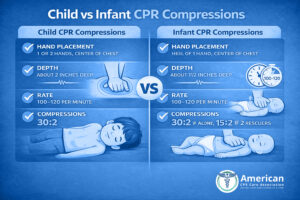
  • Use one hand (or two if needed).
  • Compress at least 2 inches deep (about 1/3 chest depth).
  • Rate: 100–120 per minute.

Airway and breaths are the same as adults.

Infant CPR

Compressions:

  • Use either the two-thumb encircling hands technique or, if you cannot encircle the chest, compress the sternum with the heel of one hand.
  • Hand placement should be in the center of the chest just below the nipple line.
  • Compress about 1½ inches (1/3 chest depth).
  • Rate: 100–120 per minute.

Airway:

  • Tilt the head slightly.
  • Do not over-tilt.

Breaths:

  • Cover both the mouth and nose with your mouth.
  • Give gentle breaths.
  • Watch for chest rise.

If alone and collapse was not witnessed:
  • Give 5 cycles before leaving to call 9-1-1. 

Eng--Child-and-Infant-CPR-ACCA_V2