




Public Confidence in Performing CPR Rises — Survey Insights & What That Implies
Apr 14, 2026

Last Updated On: February 9, 2026
In a cardiopulmonary resuscitation (CPR) emergency, every second matters because the brain and lungs need oxygen right away to avoid serious damage. That’s why rescuers always check and open the airways first using simple steps like the head-tilt, chin-lift. A patent central airway means air can pass freely, which helps in effective CPR to save a life.
In this blog, you’ll learn more about how doctors check for patent central airways and why it’s a key part of respiratory health.
Central airways are the main tubes in your lungs that let air move in and out when you breathe. These include the trachea (windpipe) and the large bronchi, which branch off from the trachea to carry air deeper into the lungs.
So, if doctors say your central airways are patent, it means air can flow freely through them without any obstruction. This is important because your body needs oxygen to work properly. If the airway is non-patent, it becomes harder for the person to breathe.
In medical terms, “patent” means open and not blocked. A patent airway lets air flow freely into and out of the lungs. This is important for breathing correctly and getting oxygen to the brain, heart, and other important organs.
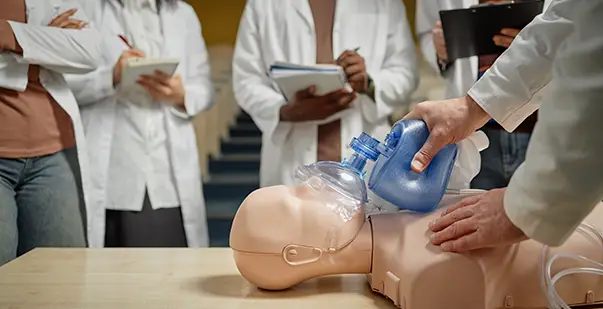
One of the first and most crucial things to do during CPR is to make sure the airway is open. Rescue breaths can’t get to the lungs if the airway is closed, and oxygen can’t get to where it’s needed. Rescuers use certain techniques to maintain the patent airway. These are the most prevalent ones:
This is the most commonly used technique to patent central airways in an unconscious person with no suspected neck injury. The rescuer gently tilts the person’s head back by placing one hand on the forehead and lifting the chin with the other hand. This helps move the tongue away from the back of the throat, which is a common cause of airway blockage.
If there is a chance the person has a neck or spine injury (for example, after a fall or car accident), the jaw-thrust maneuver is used instead of tilting the head. The rescuer places their fingers behind the angle of the jaw and gently pushes it forward. This lifts the tongue away from the airway without moving the neck.
According to the National Library of Medicine, a study on 72 adults compared three CPR head positions during anaesthesia:
The results showed that the jaw thrust and tilting the head back allowed the most airflow. The neutral position still gave enough airflow, but less than the other two. Air leaks were most common when the head was straight and least common when it was tilted back.
Sometimes, simple head-tilt or jaw-thrust maneuvers aren’t enough to keep a patient’s airway open. In these cases, rescuers use airway adjuncts—devices designed to prevent the tongue or soft tissues from blocking airflow. Two of the most common adjuncts are:
An oropharyngeal airway is a curved plastic device inserted into the mouth of an unconscious person. It keeps the tongue from falling back and blocking the airway. OPAs are only used in people who are not awake, because they can trigger gagging or vomiting in someone who’s conscious.
A nasopharyngeal airway is a soft tube that runs through the nose and into the throat. It helps keep the airway open and can be used on people who are awake or asleep, especially if they have a mouth injury or gag reflex that makes it hard to use an OPA.
One of the main goals of clinical practice is to keep a patient’s airway open (patent). In the operating room, intensive care unit, or emergency room, the ability to keep a patent central airway directly affects how well oxygen is delivered, how safe anesthesia is, and how well patients survive.
Even a small amount of airway loss can make treatment less effective, slow down recovery, or make things worse very quickly. Because of this, healthcare teams put a lot of emphasis on keeping an eye on the airway at all times, acting quickly, and making sure that everyone knows about the airway status.
A patent airway allows oxygen to move from the environment into the lungs and then to the body tissues. Blockages can be caused by food, swelling, or the tongue falling back, especially in unconscious patients. If the airway is not open, oxygen delivery stops, no matter what care is being given.
Before giving a patient sedation or general anesthesia, it’s important to check and secure their airway. Sedation relaxes the muscles, which can increase the risk of blockage. That’s why continuous monitoring is used during procedures, to make sure the patient gets enough oxygen and to prevent low oxygen levels (hypoxia).
As part of the initial assessment in emergency and intensive units, checking of the airway takes precedence. If the airway isn’t staying open on its own, doctors may use special devices, insert a breathing tube (intubation), or perform a surgical procedure to open the airway.
Managing the airway is a team effort. Nurses, paramedics, respiratory therapists, and other healthcare workers all play a role.
When there is a central airway blockage, air can’t reach the lungs properly. This can turn serious very quickly. If not treated in time, it may lead to brain damage, lack of oxygen, or even death. Knowing what to look for and acting fast can help save a life.
These signs appear at the start of an airway problem. Breathing may start to sound louder or harsher. Catching these signs early can prevent the airway from fully closing.
In a partial blockage, some air still gets through. The person may be able to talk or cough, but breathing is still hard.
With a full blockage, no air gets through at all. This is a life-threatening emergency.
These physical signs show that oxygen is running low and the body is struggling.
In unconscious people, airway blockages can be harder to spot. Close attention is needed.
When a patient arrives at a hospital, checking the airway is one of the first steps. This process is fast and critical for survival. Here’s what the steps look like:
The first check is quick and relies on basic senses—looking, listening, and feeling for signs of airflow.
In emergencies, airway evaluation is part of the ABC approach:
The airway is always assessed and cleared first. Without a patent airway, oxygen cannot reach the lungs or body tissues, regardless of breathing or circulation status.
A closer examination follows to identify visible or physical causes of obstruction.
Clinical Tools for Assessment
|
Patent central airways are the foundation of effective patient care in every clinical scenario. From initial assessment to immediate treatment, seconds count in ensuring oxygen makes its way to the lungs and life-sustaining organs. Knowing how to recognize obstructions right away can be the difference between life and death.
As a healthcare student or professional aiming to enhance knowledge in airway management, register for our CPR Course today. Learn the knowledge and confidence to rescue lives when you need to.
Read More:
Subscribe
Search Here
Select Courses
Recent Posts
Categories