




Low-Cost Mechatronic Devices for Assisted CPR: Emerging Prototypes
Sep 15, 2026
Last Updated On: September 15, 2026
Did you know that an average adult heart beats about 60 to 100 times per minute when resting?
Learning how to check your pulse gives you a practical way to monitor your body’s condition without any machines or medical background. Whether you are cooling down after a workout, feeling light-headed, or simply curious, measuring your pulse provides useful insight into your heart’s status. Furthermore, in emergency situations, knowing how to check another person’s pulse accurately can assist in assessing their condition and deciding when to call for professional help. In this guide, we will show you simple methods to measure your pulse, what the results mean, and when to seek medical guidance.
A recent study published in the Trends in Cardiovascular Medicine journal found that every 10-bpm increase in resting heart rate was linked to a 17% higher risk of death in men. Your pulse is the pressure wave felt as blood is pushed through your arteries with each heartbeat; it’s not the beat itself.
Even a small change in resting pulse can add up: at 80 bpm, the heart beats about 115,000 times per day. Healthcare practitioners never neglect to take the pulse because it changes immediately in exercise, stress, or disease. Pulse is also referred to as a ‘vital sign’ like blood pressure and temperature.
By training to take your own pulse, you can learn at an early age whether you discover unusual changes and whether you should visit your doctor.
Call 911 right away if:
It’s important to understand the heart rate vs pulse rate difference. Even though highly related to each other, the heart rate is how often the heart beats within any minute of time, whereas the pulse rate refers to the number of pressure waves felt through the arteries during that same time period.
Your pulse rate changes with age, activity, and overall health. Knowing the normal range for your age group helps you understand whether your heartbeat is regular or if you should check with a healthcare provider. The accepted normal pulse rates by age appear in the following table:
| Age Group | Pulse Rate |
| Newborns (0–1 month) | 100 – 180 bpm |
| Infants (1–12 months) | 100 – 160 bpm |
| Children | 75 – 120 bpm |
| Adults | 60 – 100 bpm |
Note: Ranges may vary depending on fitness level and health conditions
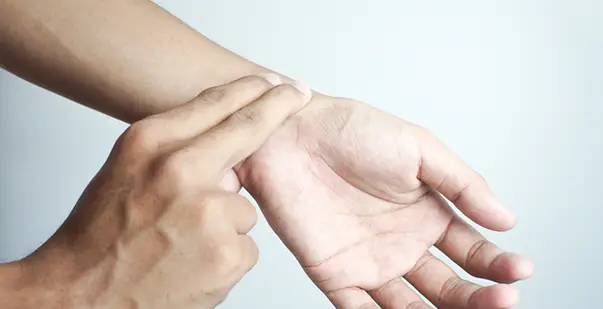
When you take your pulse, you are actually sensing the throb of the blood through an artery. There are some areas of the body where pulses can be felt most easily. Although the wrist and neck are most popular among everyday people, doctors and other healthcare workers tend to utilize other pulse points in order to take pulses during their examinations.
| Pulse Point | Location | How to check | Common Use |
| Radial Pulse | Wrist, below the thumb | Place the index and middle fingers on the inside of the wrist | Most common for quick checks |
| Carotid Pulse | Side of the neck, beside the windpipe | Gently press with two fingers with light pressure on one side | Often used in CPR and emergencies |
| Brachial Pulse | Inner elbow, near the crease | Place fingers between biceps and triceps | Used in infants and for blood pressure measurement |
| Femoral Pulse | Groin area, near the hip crease | Press firmly but gently with fingers | Assessed in trauma or critical care |
| Apical Pulse | Chest, over the heart | Listened with a stethoscope | Important for heart assessments in healthcare |
| Temporal Pulse | Side of the head, near the temple | Press lightly with fingers | Sometimes used in children or for headache checks |
| Popliteal Pulse | Behind the knee | Bend the knee slightly and press | Used in circulation checks in the legs |
Note:
Many people use modern devices to check their pulse. In a 2025 survey, about 32% of U.S. adults said they regularly used a smartwatch to monitor their heart. Below are common methods to measure pulse:
| Method | How It Works |
| Manual Palpation |
|
| Smartwatch/Tracker |
Note: These assess pulse rate but not the quality or rhythm of the pulses and can be less precise with movement or irregular rhythms. |
| Smartphone App |
Note: They are not FDA-approvable medical devices and cannot be used in place of methods with medical-grade equipment. |
| Pulse Oximeter |
Note: The reliability may be affected by cold fingers, nail polish, difficulty with circulation, or movement. |
| Stethoscope/BP Monitor |
|
Each technique has both pros and cons. The manually checked method has no equipment but depends on the technique. Gadgets offer convenience. Choose the method that fits your situation and comfort.
Nearly two-thirds of people use a device to monitor their heart health. At home, you can learn how to check your pulse by following the steps given below:
Sit down and relax for a few minutes before checking your pulse. This helps you get an accurate reading instead of one affected by movement or stress.
Common places to check your pulse are your wrist (radial pulse), neck (carotid pulse), or the inside of your elbow (brachial pulse). Use whichever feels easiest for you. However, the wrist is safest for most people.
Put the tips of your middle and index fingers lightly over the pulse spot. Don’t attempt it with your thumb because it also has the pulse and would give you the wrong reading.
Press gently until you locate the stronger beat of the heart. You may not be ready to locate it right away; move your fingers slightly until the pulse becomes clearly visible.
After you find the pulse, count the beats you feel in 60 seconds. You can count in 30 seconds and double it if you like.
If your first measurement feels off, try again after a few minutes. Practice makes it easier to find and measure your pulse accurately.
Write down your pulse rate along with the time, date, and any symptoms (like dizziness or palpitations). This helps track this over time for your doctor.
In a major study, each 10-bpm increase in resting heart rate corresponded to a 16% higher risk of death. Many things can cause your pulse to change, from everyday activities to long-term health conditions. Understanding these factors helps you know what’s normal and when changes might need attention.
| Factor | Effect on Pulse | Key Points |
| Age and Fitness | Varies with age and conditioning |
|
| Illness and Fever | Increases (typically by 10–15 bpm per 1°C rise in temperature) |
|
| Physical Activity | Rises during exercise |
|
| Emotions and Stress | Rises temporarily |
|
| Medications and Substances | Increases or decreases depending on the type |
|
Knowing how to check your own pulse is an easy and effective method to keep you in touch with the health of your heart. It can aid in spotting trouble soon enough in its earliest signs, track your progress in staying fit, and learn how your body copes with the strains of stress or illness. Taking the pulse at regular intervals just takes one minute, but it can go a long way in protecting your heart health.
Want to learn more life-saving skills? Learn CPR today and possibly be in the position to save the life of someone close during the time it really counts. Enroll in an accredited CPR training course and become confident in responding at the time it really counts.
Read More:
Subscribe
Search Here
Select Courses
Recent Posts
Categories