





Kitchen Safety: Preventing and Treating Burns and Cuts at Home
Mar 26, 2026
Last Updated On: January 19, 2026
Cardiopulmonary resuscitation (CPR) is an important life-saving skill that helps resuscitate victims in cardiac emergencies. It helps improve survival rates to a great extent and is considered a key skill that professionals from every field should possess in the long run. Since August 2018, 38 states in the U.S. passed laws requiring students to enroll in hands-on, guidelines-based CPR training before high school graduation. A growing number of states also mandate automated external defibrillator (AED) access and emergency action plans in schools.
Understanding what your state requires and how to implement training, drills, and device maintenance helps districts meet the rules and improve campus readiness. In this guide, we will discuss the overall CPR in schools law in detail.
Generally, there are two types of state policies:
However, there is no federal law mandating AEDs in all schools. Moreover, the requirements vary by state, as showcased in this timeline for the latest CPR and AED requirements in schools across some U.S. states.
| State Name | Timeline | CPR Training | AED Training |
| Arizona | 2017-18 | Required for high school graduation | Needed for public high schools that sponsor an athletic team or sports program |
| Arkansas | 2017-18 | Required for high school graduation | Needed in public schools |
| Connecticut | 2016-17 | Required for high school graduation | Needed in schools (provided funding is available) and public golf courses |
| Delaware | 2014-15 | Required for high school graduation | Required for high school graduation |
| District of Columbia | 2017-18 | Required for high school graduation | Required for all schools |
| Florida | 2021 | Required for high school graduation | Mandatory for members of the Florida High School Athletic Association (FHSAA) |
| Georgia | 2014-15 | Required for high school graduation | Necessary in certain high schools and facilities that perform sedation or anesthesia |
| Idaho | 2015-16 | Required for high school graduation | Required for high school graduation |
| Illinois | 2015-16 | Required for high school graduation | Required for all schools |
| Indiana | 2015-16 | Required for high school graduation | Required for all schools |
| Kansas | 2016-17 | Required for high school graduation | No legislation |
| Kentucky | 2016-17 | Required for high school graduation | No legislation |
Source: American Heart Association
No federal laws exist that mandate, enforce, or help schools across the U.S. acquire AEDs. However, a few of these states are making advancements by introducing CPR training mandates that automatically include topics related to defibrillation. Let’s review some of these states that have implemented such lifesaving policies and technology after 2023 to help anyone respond successfully in medical emergencies:
Senate Bill 369 took effect on July 1st in Indiana. Starting in 2023, it required schools across the state to ensure AEDs are present across all sporting and extracurricular events. The law also requires emergency action plans, drills, and training for staff and students to improve the likelihood that these AEDs will be used effectively in emergencies.
From 2023-2024, Alabama introduced HB 45, which requires all K-12 public and private schools to take several preventative measures to lower the risk of sudden cardiac death on campuses. As a part of this requirement, coaches and athletic trainers must receive and renew their CPR and AED training every two years.
Ohio’s House Bill 47 mandates emergency action plans and AED accessibility across all public and private schools. This legislation is based on Lindsey’s Law 2017, which ensured all parents and students formally acknowledged the risk factors of SCA before participating in school sports and other activities.
Bill 331 requires every building across middle and high schools in Kentucky to have one readily accessible and portable AED, starting in 2025-2026. This bill also represents a strong effort to keep children safe from the threat of cardiac arrest by equipping facilities with AEDs across campuses. House Bill 331 also takes into account training requirements that can easily support the use and maintenance of these devices.
Read More: The Value of CPR & ACLS Training for Workplace Safety
Adequate training in CPR and AED for teachers and students helps in school emergency preparedness across any situation. This benefits everyone in the following ways:
CPR training enables students and teachers to recognize what to do when a person is hurt or cannot breathe properly. Trained individuals can immediately start chest compressions and use an AED while emergency responders are on the way. This early action can significantly increase the victim’s chance of survival.
When teachers or coaches are trained in hands-only CPR and AED, they can easily help save lives. These actions are usually known to improve survival in cardiac arrest. Training reinforces a simple trigger: if a person is unresponsive and not breathing normally, start CPR and use an AED when available.
Knowing CPR makes school campuses more secure for everyone, especially by making them prepared for sudden cardiac arrest events. Teachers who know all evidence-based CPR instructions can take care of their colleagues and students, and vice versa. If something unexpected occurs, like someone unexpectedly becoming ill or having trouble breathing, anyone can come forward to help the victim.
Teachers, coaches, and staff trained in CPR set a strong example for students. Their readiness to respond demonstrates responsibility and care, and encourages everyone to seek their own student CPR certification. As a result, schools promote a culture of safety, empowerment, and preparedness that extends beyond the classroom.
A practical rollout of CPR and AED training programs easily balances curriculum, people, and equipment. Here’s how you can easily implement CPR programs across schools:
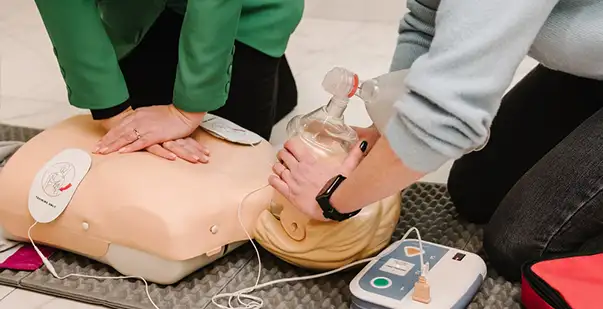
Build instruction into health or physical education courses and ensure hands-on practice with smart CPR manikins and trainer AEDs. Make sure these resources are aligned with the latest AHA/Red Cross-recognized standards.
Define who calls 911, who starts CPR, who retrieves the AED, who meets EMS, and how you debrief. Use Project ADAM templates and checkpoints as many districts pursue Heart-Safe School designation. Aim for an AED placement that allows a ≤3-minute round-trip from collapse to shock.
Consider designating an on-campus emergency response team, where at least 10% of staff must be trained in CPR or AED. They can help you in conducting short AED drills (often 5–10 minutes) that can be faster than a fire drill.
Position AEDs in clearly marked, central locations (gym, main office, cafeteria, near athletic fields). Keep devices registered with local EMS (often required), check pads or batteries before expiry. Never forget to run documented inspections, a step some laws now mandate during safety reviews.
Budget is a real concern for the U.S. states, adding devices, training, and drills in the coming days. Here is a list of some common options to explore:
The HRSA Rural Access to Emergency Devices (RAED) program has historically provided funding for AEDs and CPR or AED training in rural communities. Meanwhile, foundations and corporate programs (e.g., Medtronic HeartRescue) periodically fund school-based implementations. Do not forget to check current cycles and eligibility.
Some states also allocate funds or accept donations earmarked for CPR or AED instruction or device purchases. Check state education or health departments for grant rounds and guidance. Some states publish model AED plans and provide district implementation timelines (e.g., Ohio ODH’s model plan pursuant to HB 47).
Reputable AED suppliers maintain grant guides and update windows to apply. They can also help districts identify opportunities and budget ranges. Some vendors maintain grant directories and RFP calendars, so verify eligibility and device specifications before purchase.
Many laws encourage public-private partnerships to offset costs for AED procurement, maintenance, and training, especially in athletics. Consider local hospitals, EMS, health systems, and parent-teacher organizations as co-funders.
Read More: The Best CPR Training Apps for Skill Reinforcement
School CPR programs are evolving from one-time lessons to a culture of continuous readiness. Districts are moving from “teach it once” to maintaining preparedness through annual drills, AED device inspections, staff certification tracking, and EMS-integrated emergency response plans. States adopting AED legislation increasingly link training requirements with broader action frameworks, such as model Emergency Action Plans (EAPs) and readiness audits, to ensure that skills translate into real response capability.
Emerging tools, like AED registries synced with 911 dispatch systems or smart cabinets that log device access and maintenance, illustrate how technology is enhancing accountability and visibility. Training practices are also becoming more data-driven, with the use of feedback manikins to improve compression quality and real-time performance.
As schools refine their readiness systems, the focus remains clear: every minute matters in sudden cardiac arrest. By building consistent, connected, and technology-supported response programs, educational institutions can strengthen the chain of survival where it matters most, right on campus.
Confirm whether CPR is a high school graduation requirement, what grade bands are specified, whether AED practice is mandated, and any device or inspection requirements. AHA’s map is a good starting point because it allows you to read the latest or actual bill text for your state. So, if you are a district leader, here are some practical steps to follow:
Define roles, routes to AEDs, drill cadence, debriefing, and EMS integration. Write or update your CERP to ensure your team can respond quickly, confidently, and in full coordination during a cardiac emergency.
Map AED locations to response times and always aim for a 3-minute round-trip. Next, you may set monthly check routines and plan pad or battery replacements. Tie purchases to grant timelines.
Go beyond the minimum to certify coaches and activity leaders. You can also maintain staff rosters with renewal dates. Even starting CPR later confers a survival benefit over no CPR.
Track the number of students and staff trained, drill response times, and AED readiness. Share results with your school board and community to analyze where the training has garnered any positive results.
The newest wave of CPR in schools law is about speed and skills. This involves equipping your campus for cardiac emergencies. The process can begin with teaching students early, training staff continuously, and keeping AEDs visible and inspected. You can also seek help from our 100% online, self-paced CPR/AED courses to help teachers, coaches, and students build confidence and meet state training expectations. This allows you to give every student and staff member the best chance when seconds count. Interested in equipping everyone with the latest CPR and AED skills? Let them enroll in an online CPR certification now!
Subscribe
Search Here
Select Courses
Recent Posts
Categories